

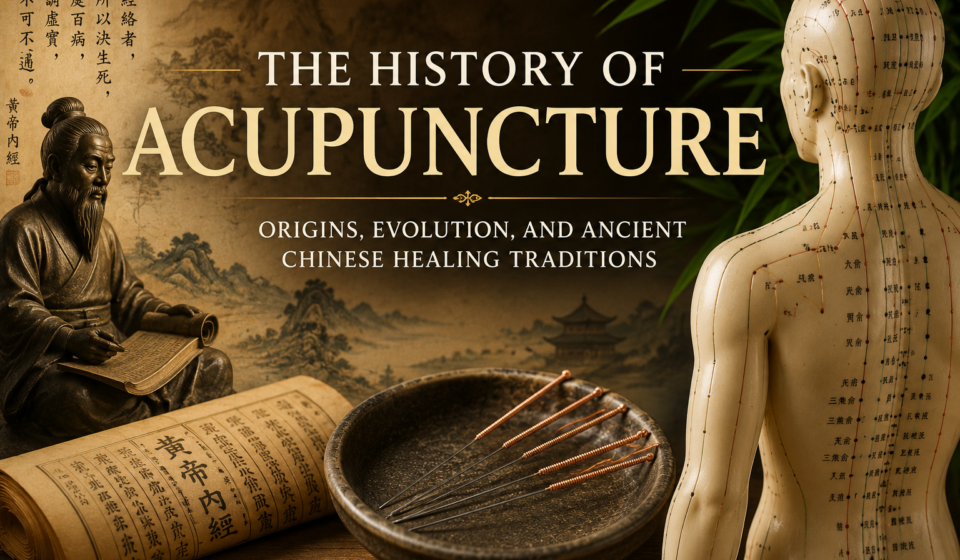
The History of Acupuncture: Origins, Evolution, and the Ancient Wisdom Behind a Timeless Healing Practice
Acupuncture is one of the oldest healing practices still used today. For thousands of years, people have sought acupuncture to relieve pain, improve health, restore balance, and promote overall well-being. While modern medicine continues to advance through technology and scientific discovery, acupuncture remains a respected form of complementary healthcare practiced around the world.
But where did acupuncture come from? Who created it? What inspired the development of this unique healing system? To understand acupuncture, we must travel back thousands of years into ancient China and explore the philosophies, observations, and experiences that shaped one of humanity’s most enduring medical traditions.
The Origins of Acupuncture
The origins of acupuncture can be traced back more than 2,000 years, although some historians believe its roots may extend as far back as 4,000 to 5,000 years. Acupuncture developed in ancient China during a time when people relied heavily on observing nature, understanding seasonal changes, and studying the human body’s response to illness and injury.
The earliest evidence of acupuncture-like practices comes from sharpened stones known as “Bian Shi.” Archaeologists have discovered these stone tools dating back to the Neolithic period. These instruments were likely used to stimulate specific areas of the body to relieve pain or treat various ailments.
Unlike modern acupuncture needles made from stainless steel, these early tools were crafted from stone, bone, or bamboo. While primitive by today’s standards, they represented humanity’s first attempts to influence health through targeted physical stimulation.
As Chinese civilization evolved, so did its medical understanding. The development of bronze and metalworking technologies eventually led to the creation of finer instruments that more closely resembled modern acupuncture needles.
Ancient Chinese Philosophy and Medicine
To understand acupuncture’s creation, it is important to recognize that ancient Chinese medicine was deeply connected to philosophy.
Unlike modern Western medicine, which often focuses on individual organs and biological systems, traditional Chinese medicine viewed the body as an interconnected whole. Health was believed to depend on balance and harmony between various forces within the body and the surrounding environment.
One of the foundational concepts behind acupuncture is the idea of Qi (pronounced “chee”).
Qi is often translated as “life force,” “vital energy,” or “life energy.” Ancient Chinese practitioners believed that Qi flowed throughout the body along specific pathways known as meridians. When Qi flowed freely, a person enjoyed health and vitality. When Qi became blocked, deficient, or imbalanced, illness and pain could occur.
This concept was heavily influenced by observations of nature. Ancient scholars noticed that rivers flowed through landscapes, nourishing the land. When rivers became blocked, problems emerged. Similarly, they believed energy flowed through the body and that disruptions in this flow contributed to disease.
Acupuncture was developed as a method to restore proper movement and balance of Qi.
The Influence of Yin and Yang
Another major inspiration behind acupuncture was the Chinese philosophical concept of Yin and Yang.
Yin and Yang represent complementary forces found throughout nature:
- Light and dark
- Day and night
- Activity and rest
- Heat and cold
- Expansion and contraction
Ancient Chinese thinkers believed that health depended on maintaining balance between these opposing yet interconnected forces.
For example:
- Excessive Yang might manifest as inflammation, fever, or agitation.
- Excessive Yin might appear as fatigue, coldness, or sluggishness.
Acupuncture was developed as a way to help restore balance between Yin and Yang within the body.
Even today, many acupuncture diagnoses are based on identifying patterns of imbalance rather than focusing solely on individual symptoms.
The Yellow Emperor’s Classic of Internal Medicine
One of the most important texts in acupuncture history is the “Huangdi Neijing,” commonly translated as “The Yellow Emperor’s Classic of Internal Medicine.”
Written approximately between 300 BCE and 100 BCE, this ancient medical text is considered the foundational document of Traditional Chinese Medicine.
The book takes the form of conversations between the legendary Yellow Emperor and his physicians. It discusses:
- Human anatomy
- Physiology
- Disease processes
- Diagnosis
- Prevention
- Acupuncture techniques
Many of the meridians and acupuncture points used today were first described in this text.
Although modern historians recognize that the book was likely written by multiple authors over time, its influence on Chinese medicine cannot be overstated. It served as a medical guide for generations of practitioners and remains a foundational reference even today.
How Ancient Practitioners Discovered Acupuncture Points
One fascinating question is how ancient practitioners identified acupuncture points without modern imaging technology.
The answer lies largely in observation and experience.
Over centuries, practitioners carefully documented how stimulating certain areas of the body affected symptoms elsewhere.
For example:
- Pressing one area might relieve headaches.
- Stimulating another area could improve digestion.
- Treating a specific point could reduce pain in a distant body region.
Through trial, observation, and generations of accumulated knowledge, a system of acupuncture points gradually emerged.
This process was similar to how many early medical discoveries occurred throughout human history. Long before advanced scientific instruments existed, people relied on patterns, outcomes, and repeated observations.
The Evolution of Acupuncture Needles
As Chinese technology advanced, acupuncture instruments became increasingly sophisticated.
Early tools included:
- Sharpened stones
- Bone needles
- Bamboo needles
Later, metalworking innovations allowed practitioners to create needles from:
- Bronze
- Iron
- Silver
- Gold
Ancient medical texts describe several types of needles designed for different therapeutic purposes.
Modern acupuncture needles are significantly thinner than hypodermic needles used for injections. They are typically sterile, disposable, and designed to minimize discomfort.
The evolution of these tools helped acupuncture become safer, more precise, and more widely accepted.
Acupuncture Spreads Across Asia
As Chinese influence expanded throughout Asia, acupuncture spread to neighboring countries.
It was adopted and adapted in:
- Korea
- Japan
- Vietnam
- Mongolia
Each culture developed its own unique styles and interpretations while preserving many of the core principles of traditional Chinese medicine.
Japanese acupuncture, for example, often uses thinner needles and gentler techniques. Korean acupuncture developed specialized systems focused on hand acupuncture and constitutional medicine.
Despite regional differences, the central concept of restoring balance and promoting natural healing remained consistent.
Acupuncture Meets the Western World
Acupuncture remained largely unknown in the Western world for centuries.
Although travelers occasionally documented Chinese medical practices, widespread interest did not emerge until the twentieth century.
One significant turning point occurred in 1971 when American journalist James Reston wrote about receiving acupuncture treatment during a visit to China. His article in The New York Times introduced many Western readers to acupuncture for the first time.
As diplomatic relations between China and the United States improved, interest in Chinese medicine grew rapidly.
Researchers began studying acupuncture’s effects on pain management and other health conditions. Hospitals and medical institutions started exploring its potential role alongside conventional treatments.
Today, acupuncture is practiced in countries throughout the world.
Modern Scientific Perspectives
Modern science continues to investigate how acupuncture works.
While traditional explanations focus on Qi and meridians, researchers have proposed several biological mechanisms.
Studies suggest acupuncture may:
- Stimulate nerve pathways
- Trigger endorphin release
- Influence neurotransmitters
- Improve blood circulation
- Modulate inflammatory responses
- Affect the autonomic nervous system
Although researchers continue to debate specific mechanisms, many clinical studies have found acupuncture helpful for certain conditions, particularly chronic pain management.
Organizations such as the World Health Organization and various medical institutions recognize acupuncture as a valuable complementary therapy for select conditions.
Why Acupuncture Has Endured for Thousands of Years
Few medical practices have survived for thousands of years.
Acupuncture’s longevity can be attributed to several factors:
Adaptability
Acupuncture evolved alongside changing societies and technologies while preserving its foundational principles.
Holistic Perspective
Many people appreciate its focus on the whole person rather than isolated symptoms.
Observational Success
Generations of practitioners documented clinical outcomes, allowing knowledge to accumulate and improve over time.
Integration with Modern Healthcare
Today, acupuncture is often used alongside conventional medicine rather than in opposition to it.
Patients may seek acupuncture for pain management, stress reduction, rehabilitation, and overall wellness while continuing to receive modern medical care.
The Legacy of Acupuncture
Acupuncture represents more than a medical technique. It reflects humanity’s long-standing desire to understand health, alleviate suffering, and live in harmony with nature.
What began as simple observations by ancient healers eventually evolved into a sophisticated medical system that continues to serve millions of people worldwide.
Whether viewed through the lens of traditional philosophy or modern scientific research, acupuncture remains a remarkable example of how ancient wisdom can endure across centuries.
Its history reminds us that healing traditions often arise from careful observation, curiosity, and a deep commitment to improving human well-being. As acupuncture continues to evolve in the modern era, it stands as a bridge between ancient knowledge and contemporary healthcare—an enduring testament to the human pursuit of health, balance, and vitality.