


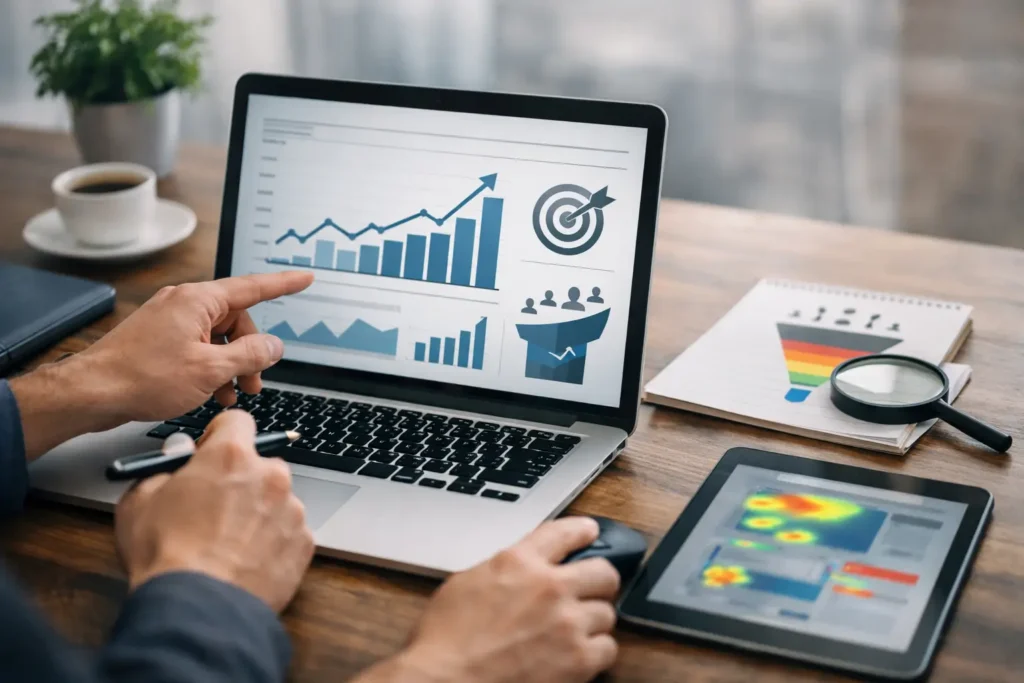
A lot of small businesses do not have a traffic problem. They have a conversion problem.
If your site is getting visits but not enough calls, form submissions, or booked appointments, website conversion rate optimization is usually the missing piece. It is the work of turning more of your existing traffic into real business results. For a local service business, that can mean more estimate requests, more consultations, more appointment bookings, and fewer leads slipping through the cracks.
This matters because buying more traffic before your website is ready often wastes money. If a visitor lands on your site and feels confused, unsure, or unconvinced, they leave. A better ad budget will not fix that. A better conversion system will.
What website conversion rate optimization really means
At its core, website conversion rate optimization is about reducing friction and increasing trust. You are helping the right person take the next step with less hesitation.
That next step depends on your business model. For a financial professional, it might be scheduling a consultation. For an acupuncturist, it might be booking an appointment. For a contractor, it might be requesting a quote. Different businesses need different conversion actions, but the goal is the same – make the next step clear, simple, and worth taking.
Many business owners assume conversion optimization is about changing button colors or testing tiny details. Those things can matter, but they are rarely the first issue. In most cases, the biggest gains come from fixing the basics: weak messaging, unclear offers, slow pages, cluttered layouts, missing trust signals, and poor follow-up after the form is submitted.
Why local businesses lose conversions
Most underperforming websites fail in predictable ways. They ask visitors to do too much thinking.
A local customer should be able to land on your site and quickly answer a few basic questions. What do you do? Who do you help? Why should they trust you? What should they do next? If any of those answers are buried, vague, or missing, your conversion rate drops.
This is especially common with service businesses that built a website years ago and never updated the structure. The site may look acceptable at a glance, but it does not guide visitors well. It reads like a brochure instead of functioning like a lead generation tool.
There is also a second issue many owners overlook: the website may not be the only point of failure. If leads come in and sit unanswered, if there is no automated confirmation, or if booking is inconvenient, conversion suffers after the click too. That is why the strongest results usually come from improving both the website and the systems behind it.
The pages that usually matter most
Not every page on your website needs equal attention. For most small and midsize businesses, a few high-intent pages create the majority of conversions.
Your homepage matters because it often sets the first impression. Your service pages matter because they capture people searching for specific solutions. Your contact or booking page matters because it is where intent turns into action. If you run paid ads or local campaigns, landing pages matter even more because they should match the message that brought the visitor there.
A common mistake is spreading effort across the entire site before fixing these core pages. Start where buyer intent is highest. That is where conversion improvements usually pay off fastest.
How to improve website conversion rate optimization
The best approach is practical. You do not need a complicated testing lab. You need a site that makes it easy for the right visitor to say yes.
Start with your headline. Above the fold, your site should clearly say what you offer and who it is for. Clever wording is usually less effective than direct wording. A visitor should not need to scroll to figure out whether they are in the right place.
Next, tighten your calls to action. If every page asks people to “learn more,” you are likely creating unnecessary friction. Strong calls to action are specific and aligned with buying intent, such as “Book Your Consultation,” “Request a Quote,” or “Schedule an Appointment.” That wording tells visitors exactly what happens next.
Then look at trust. Local businesses often underestimate how much reassurance people need before contacting them. Reviews, testimonials, certifications, years in business, location details, photos of your team, and clear service information all help reduce uncertainty. For relationship-based services, trust is not decoration. It is part of the conversion path.
You should also simplify forms. A long intake form may seem useful for qualifying leads, but too many required fields can reduce submissions. There is a trade-off here. If you need detailed information to screen prospects, a longer form might improve lead quality even if volume drops. But if your pipeline is too thin, reducing fields often improves performance.
Mobile experience deserves close attention as well. A large percentage of local traffic comes from phones. If your site loads slowly, your buttons are hard to tap, or the booking process feels awkward on mobile, you are losing ready-to-act visitors. A site that looks good on desktop but feels frustrating on mobile is not optimized.
Conversion optimization is not just design
This is where many businesses go off track. They redesign the site and expect conversions to rise automatically.
Sometimes that happens, but design alone is not strategy. Website conversion rate optimization works best when content, structure, speed, user flow, and follow-up all support the same goal. A clean site with weak messaging can still underperform. A beautiful landing page with no CRM follow-up can still leak leads.
That is why integrated systems matter. When your website, forms, scheduling, email confirmations, text reminders, and lead tracking work together, conversions improve in a more durable way. You are not just getting more inquiries. You are building a process that turns interest into booked business.
For example, a local practice might improve conversions by adding a clear appointment CTA, simplifying the booking flow, and sending an immediate confirmation text after submission. A home service company might increase quote requests by clarifying service areas, adding social proof, and routing leads into automated follow-up. The website matters, but what happens after the form matters too.
What to measure without getting overwhelmed
You do not need a dashboard full of vanity metrics. Focus on numbers tied to revenue movement.
Start with your core conversion rate on high-intent pages. Then look at form completion, booked appointments, call clicks, and lead response time. If you can track which traffic sources produce qualified leads, even better. That helps you see whether the problem is traffic quality, page performance, or follow-up.
Be careful with quick judgments. If your traffic is low, conversion data can be noisy. A small business may not have enough volume to treat every weekly change as meaningful. In those cases, look for directional patterns over time instead of reacting to every small fluctuation.
It also helps to define what a good conversion actually is for your business. More leads are not always better if they are unqualified. Sometimes the goal is not maximum form submissions. It is more booked appointments with the right prospects.
The most effective CRO mindset for small businesses
Think of optimization as a steady improvement process, not a one-time fix.
You launch a stronger page. You see where visitors hesitate. You adjust the messaging, form length, layout, offer, or follow-up. Then you keep improving. That approach is usually more realistic and more profitable than waiting for a perfect site rebuild.
For local businesses, the biggest wins often come from simple changes done well. Clearer service positioning. Better calls to action. Faster mobile pages. Stronger trust signals. Easier scheduling. Automatic follow-up. These are not flashy changes, but they are the kind that move results.
That is also why businesses benefit from working with a partner who looks at the full path from visit to lead to booked customer. At Local Build Digital, that connected view is what helps turn websites into growth systems instead of static online brochures.
If your website already gets attention, you may be closer than you think. The next stage is not always more traffic. Sometimes it is building a site and follow-up process that finally gives your existing traffic somewhere productive to go.