


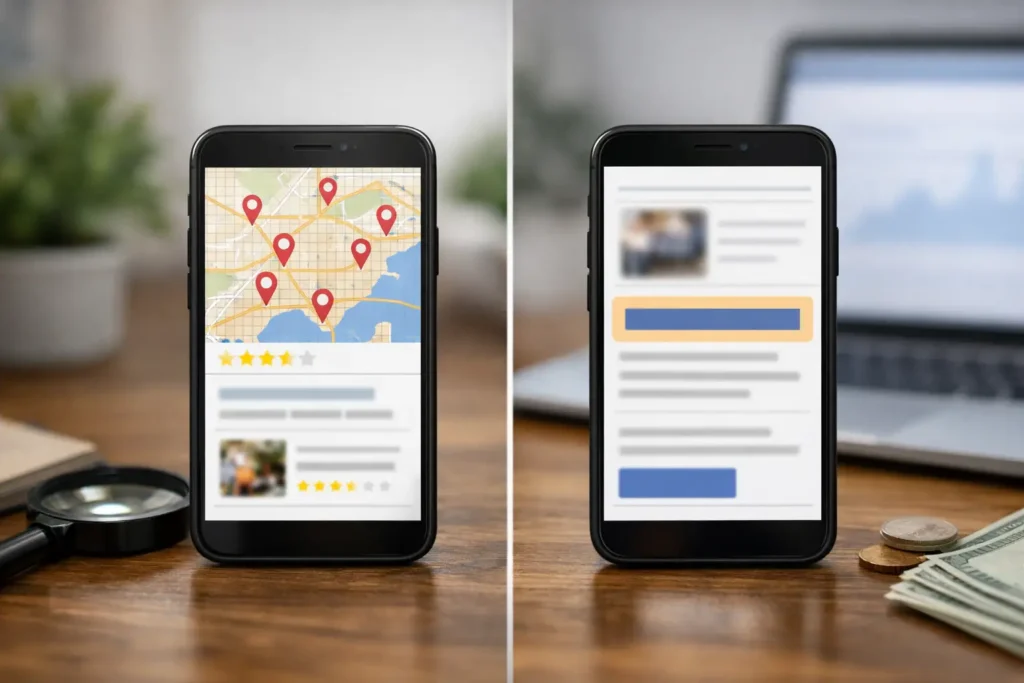
A plumbing company needs calls this week. A dental office wants steady bookings for the next year. A financial advisor wants qualified local leads, not random clicks from people outside their service area. That is where the local seo vs paid ads question gets real. It is not about picking a trendy channel. It is about choosing the right mix of visibility, speed, cost, and lead quality for how your business actually grows.
For most local businesses, this is not an either-or decision forever. It is a timing and systems decision. Paid ads can create immediate traffic. Local SEO can build long-term visibility and trust. The better choice depends on how quickly you need leads, how competitive your market is, what your website does after someone lands on it, and whether you have follow-up systems in place to turn interest into revenue.
Local SEO vs paid ads: the real difference
Local SEO helps your business appear when nearby customers search for services you offer. That can include map results, local business listings, service pages, and organic website rankings. When someone searches for terms like “acupuncturist near me” or “tax preparer in Sacramento,” strong local SEO improves your chance of being found without paying for every click.
Paid ads put you in front of searchers right away. You pay for placement, usually at the top of search results, and often pay each time someone clicks. This can work well when you need fast lead flow, have a clear service offer, and can track what happens after the click.
The biggest difference is simple. Local SEO is an asset you build. Paid ads are a tap you turn on and off. One compounds over time. The other delivers speed, but stops the moment your budget stops.
When local SEO makes more sense
If you are a local service provider with an established business and a defined service area, local SEO often creates the stronger long-term return. It helps people find you when they are already looking for what you do. Those searches usually carry high intent, especially for appointment-driven and relationship-based businesses.
A person searching for “family chiropractor in San Diego” or “bookkeeper near me” is not casually browsing. They are looking for a provider. If your Google Business Profile is complete, your reviews are healthy, your website is location-focused, and your pages answer the right local search intent, you can attract leads consistently without paying for every visit.
Local SEO also tends to build credibility in a way ads cannot fully replicate. Many people still skip sponsored listings and go straight to map results or organic listings because they trust them more. For service businesses where trust matters, such as wellness, legal, home services, and financial consulting, that trust gap matters.
The trade-off is time. SEO usually does not produce a major lift overnight. If your site is weak, your local listings are inconsistent, or your competitors are ahead of you, progress takes work. The good news is that the work compounds. A strong location page, better reviews, improved site speed, and clearer service content can keep producing value month after month.
When paid ads make more sense
Paid ads are often the smarter move when you need leads quickly, have a short runway, or want to test demand before investing deeply in long-term SEO. If you just launched a new med spa, opened a second office, or need to fill your calendar fast, ads can put your offer in front of local searchers almost immediately.
They also work well for high-intent services with clear commercial value. Emergency plumbing, roofing, personal injury, urgent dental care, and other immediate-need services often perform well because customers are ready to act. In those cases, speed matters more than patient long-term visibility.
Paid ads also give you more control. You can target zip codes, set budgets, adjust messaging, and test offers quickly. If one landing page underperforms, you can change it this week. SEO does not move that fast.
But the downside is real. Click costs can rise quickly in competitive markets. Poor targeting burns budget. Weak landing pages waste traffic. And if your follow-up is inconsistent, even good clicks can turn into missed revenue. Ads can create opportunity, but they do not fix a broken website or a slow response process.
The part most businesses miss: traffic is not the whole system
This is where a lot of small businesses make expensive mistakes. They compare local SEO vs paid ads as if the only question is how to get people to the site. In reality, your results depend just as much on what happens after the click.
If a prospect lands on an outdated website, cannot find your phone number, or fills out a form that nobody follows up on for two days, both channels underperform. The same problem happens when there is no online scheduling, no automated text confirmation, and no lead tracking. You may think the marketing is failing when the conversion process is the real bottleneck.
That is why businesses with the best results usually think in systems. They connect visibility with conversion and follow-up. A strong local search presence matters. A well-managed ad campaign matters. But so do fast-loading pages, clear calls to action, CRM tracking, and automated email or SMS follow-up.
A click is not a customer. It is the start of a process.
Cost, ROI, and lead quality
If you are deciding based on cost alone, the answer can get misleading fast. Local SEO often feels expensive upfront because you invest before you see the full payoff. Paid ads can feel more measurable because you see traffic right away. But short-term visibility is not always lower cost in the long run.
With local SEO, your cost per lead often improves over time if the work is done well. Once your pages rank, your profile gains traction, and your reviews improve, you are not paying for each visit individually. With paid ads, every lead has an ongoing acquisition cost.
Lead quality also varies. SEO leads often come from people doing their own research and comparing providers, which can create better fit and trust. Paid ads can bring highly motivated buyers too, especially when search intent is strong, but they can also attract low-intent clicks if the campaign is broad or poorly structured.
ROI depends on more than channel choice. It depends on your margins, sales cycle, average client value, and how well your team handles inbound leads. A financial planner may justify a higher acquisition cost than a low-ticket service business because one client relationship can be worth far more over time.
The smartest strategy is often both, just not equally
For many local businesses, the best answer is not local SEO or paid ads. It is local SEO first as the foundation, with paid ads used strategically.
That usually looks like this: build a fast, modern website; optimize your local presence; strengthen service pages and map visibility; improve reviews and local signals; then use paid ads to fill gaps, promote high-value services, test messaging, or drive leads during growth phases.
This approach protects you from overdependence on one channel. If ad costs rise, your organic presence still works for you. If SEO is still gaining traction, ads can keep lead flow moving. Together, they create balance between short-term momentum and long-term efficiency.
For newer businesses, the ratio may lean more heavily toward ads at first. For established businesses with solid websites and reputation, the ratio may shift toward SEO over time. There is no universal split. The right mix depends on your goals, competition, and internal capacity.
How to choose for your business right now
If you need appointments this month, paid ads may deserve priority. If you are tired of paying for every lead and want more consistent local visibility, SEO should move higher on the list. If your site does not convert and your follow-up is manual or inconsistent, fix that first before scaling either channel.
Ask a few practical questions. Do you need leads immediately or can you build over the next few months? Is your market highly competitive and expensive in paid search? Do you already have reviews, local content, and a decent website? Can you respond to leads quickly? Do you know your cost per booked appointment, not just cost per click?
The clearer your answers, the easier this decision becomes.
For many service businesses, the winning move is not choosing one side of the debate. It is building a growth system that makes every visitor more likely to become a real customer. That is where the channel question stops being confusing and starts becoming profitable.
If local SEO brings visibility and paid ads bring speed, your real advantage comes from what ties everything together – the website, the messaging, the scheduling, the CRM, and the follow-up. Get that part right, and your marketing stops feeling scattered. It starts working like a business asset.