


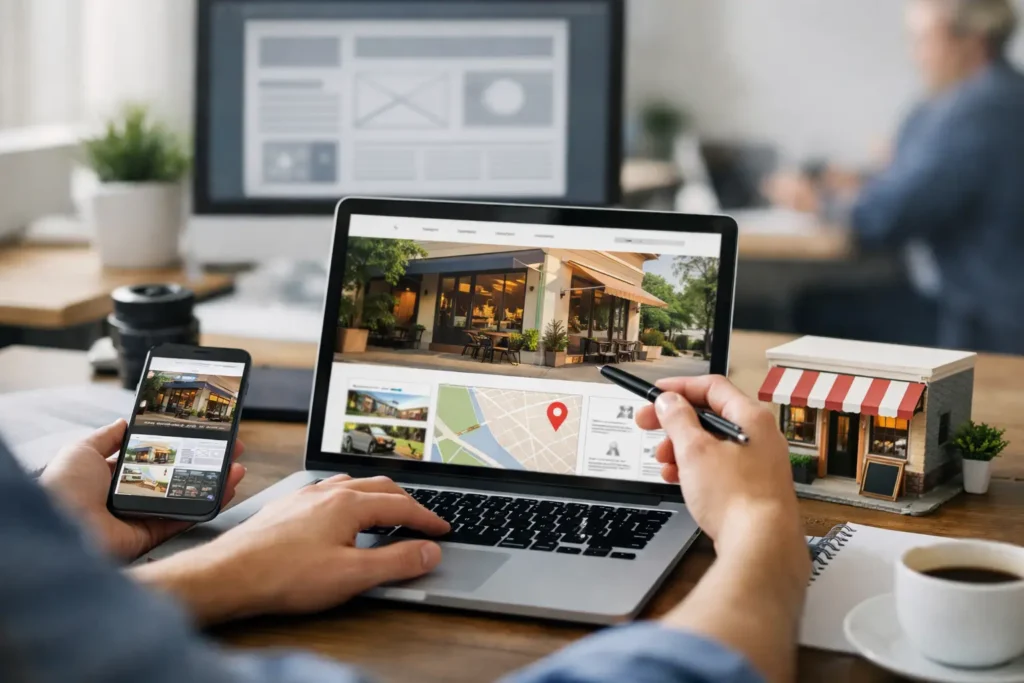
A local website should do more than look professional. It should answer the questions people ask before they call, make it easy to book or request a quote, and support the way your business actually runs. That is the real job of local business website development – building a site that helps customers find you, trust you, and take the next step without friction.
For many small businesses, the problem is not having a website. It is having the wrong kind of website. A site can be modern and still underperform if it loads slowly, hides the contact information, buries service pages, or sends leads into an inbox nobody follows up on quickly. That is where strategy matters.
What local business website development should actually do
If you run a service business, a financial practice, a wellness clinic, or any appointment-driven company, your website is part storefront, part sales tool, and part operations hub. It needs to attract local traffic, convert visitors into leads, and connect with the systems you use to manage those leads.
That last part gets overlooked all the time. A website that generates inquiries but does not connect to scheduling, CRM, email, or text follow-up creates more work instead of better results. The site may look polished, but the business still loses opportunities when response times lag or leads fall through the cracks.
Good local business website development solves both sides of the equation. It improves the customer experience on the front end and supports follow-up on the back end.
A local website is not the same as a generic small business site
There is a difference between a general website and one built for local search and local conversions. A generic site might explain what you do. A strong local site makes it easy for someone in your area to decide whether you are the right choice.
That means location matters throughout the build. Your service areas should be clear. Your contact information should be visible. Your pages should reflect the language real customers use when they search for help. If you serve Sacramento, San Diego, or a wider regional area, the structure of the site should support that instead of treating location as an afterthought.
It also means credibility signals need to be easy to find. Reviews, service details, photos, FAQs, and clear next steps all help reduce hesitation. Most local customers are not doing hours of research. They are comparing a few options and looking for the business that feels legitimate, responsive, and easy to work with.
The pages that matter most
Not every local website needs dozens of pages at launch. In fact, too many businesses delay going live because they think they need an oversized site. Usually, they need the right pages, written clearly, with a structure built to grow.
The homepage should explain who you help, what you offer, where you work, and what action to take next. It should not force visitors to decode vague slogans. People should know within seconds whether they are in the right place.
Service pages are often where conversions are won or lost. If all your services are grouped into one short page, you lose opportunities to rank locally and to speak directly to customer needs. A tax professional, an acupuncturist, and a home service contractor all benefit from dedicated pages that explain specific services in plain language.
A contact page still matters, but it should not carry the full weight of conversion. The best sites place calls to action throughout the site, not just at the end. Request a quote, book a consultation, schedule now, or call today all work when they match the service and the buyer’s level of intent.
Why design alone is not enough
Business owners often get sold on design first because it is visible. A cleaner layout, better colors, and updated images do matter. They affect trust. But design without conversion thinking is expensive decoration.
A high-performing local site guides users toward action. It uses clear headlines, straightforward navigation, mobile-friendly layouts, and simple forms. It avoids clutter, but it also avoids being so minimal that important information disappears.
There is always a trade-off here. A sleek site with very little copy may feel modern, but it can hurt search visibility and leave visitors with unanswered questions. On the other hand, a site packed with text can feel overwhelming if it is not organized well. The right balance depends on the business, the competition in your market, and how much explanation a customer needs before reaching out.
Local SEO needs to be built in from the start
One reason local business website development matters so much is that SEO works better when it is part of the build, not bolted on later. Site structure, page hierarchy, content planning, internal organization, mobile performance, and local relevance all affect visibility.
That does not mean stuffing city names into every sentence. It means building a site that gives search engines and potential customers a clear picture of what you do and where you do it. Your page titles, service pages, local language, and business details should all support that clarity.
For businesses serving multiple areas, this gets more nuanced. You do not want thin duplicate pages for every nearby city. You want location-aware content that reflects actual service coverage and real customer intent. Done well, this helps you appear in more relevant searches without creating a messy site.
Conversion happens after the click too
A website lead is not revenue until someone follows up, qualifies the inquiry, and moves that person toward an appointment or sale. That is why the strongest websites connect directly to your business systems.
If a form submission triggers an automated text, an email confirmation, and a task inside your CRM, your response process becomes faster and more consistent. If a visitor can book online without calling during business hours, you remove a common barrier. If reminders go out automatically, no-show rates can improve. These are not extra features for later. For many local businesses, they are part of what makes the website worth investing in.
This is where an all-in-one approach often outperforms a pieced-together setup. When the website, lead capture, scheduling, and follow-up tools work together, you spend less time managing software and more time serving customers. That simplicity matters, especially for small teams.
How to know if your current site is holding you back
Sometimes the signs are obvious. The site looks dated, does not work well on mobile, or gets very few inquiries. Other times the issues are quieter. Traffic may be decent, but form submissions are low. Calls may come in, but leads are not tracked. Staff may answer inquiries inconsistently because the website is disconnected from daily operations.
If your website does not clearly explain your services, support local search visibility, and make follow-up easier, it is probably doing less than it should. That does not always mean a full rebuild is the only answer. Some businesses need a complete restart. Others need better page structure, stronger calls to action, faster load times, or integration with scheduling and CRM tools.
The right recommendation depends on the gap between where the business is now and where it wants to go.
Choosing the right partner for local business website development
A good website partner should understand more than layout and branding. They should understand lead flow, local search behavior, customer friction, and the operational side of growth. That is especially important for service businesses where speed, trust, and follow-up directly affect revenue.
Ask practical questions. Will the site be built around your services and locations? Will it support SEO from the beginning? Can it connect to scheduling, CRM, forms, email, or SMS workflows? Will it be easy to update? And just as important, will the team keep the process clear enough that you do not need to become the project manager for your own website?
That clarity is a big deal. Most local business owners do not need another complicated platform to manage. They need a system that helps them show up better online and run more efficiently offline. That is why companies like Local Build Digital focus on connected growth systems instead of treating the website as a standalone asset.
A strong local website should create momentum. It should help more of the right people find you, make it easier for them to reach out, and support a faster path from inquiry to booked business. If your current site is not doing that, the opportunity is not just a better design. It is a better operating system for growth.