


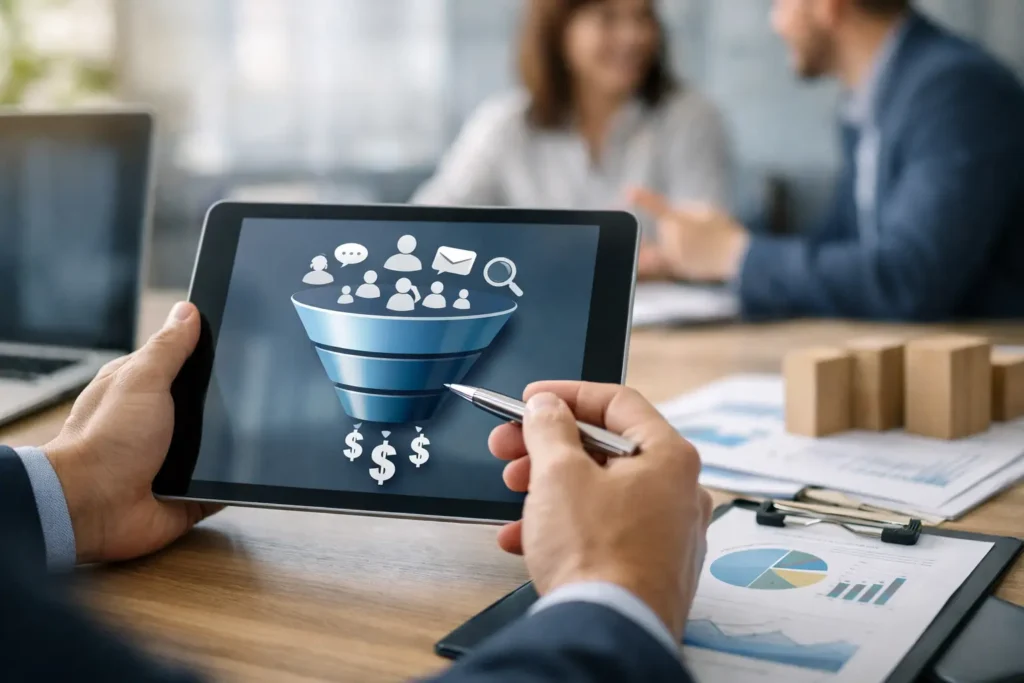
A website visit is not a lead. A phone call that goes unanswered is not an opportunity. And a contact form submitted without a fast, helpful follow-up is often business handed to the next provider in the search results. A strong lead generation funnel strategy gives local businesses a clear system for moving people from initial interest to a real conversation, scheduled appointment, or qualified estimate request.
For service businesses, the goal is not to collect the largest possible number of names. It is to create a reliable path for attracting the right prospects, giving them a reason to act, and responding before their interest fades. That takes more than a nice-looking website or an occasional social media post. It takes connected marketing and follow-up systems that work together.
Why Local Businesses Need a Funnel, Not Just Traffic
More traffic can help, but traffic alone does not solve a conversion problem. A local financial advisor may get visitors researching retirement planning. An acupuncture practice may attract people looking for relief from chronic pain. A contractor may receive clicks from homeowners comparing estimates. If those visitors land on a generic page with no clear next step, many will leave without reaching out.
A funnel creates intention at every stage. It answers the questions a potential customer is asking: Is this business credible? Do they offer what I need? Is it easy to get started? What happens after I contact them?
For most appointment-driven and relationship-based businesses, a funnel should reduce friction rather than add it. Asking someone to complete a long form before they can request a consultation may lower lead volume. On the other hand, collecting no information can fill your calendar with poor-fit inquiries. The right balance depends on the service, sales cycle, and capacity of your team.
The Four Parts of a Lead Generation Funnel Strategy
An effective lead generation funnel strategy has four connected parts: attract, convert, follow up, and improve. Each stage should support the next, so no promising inquiry is lost between a search, a form submission, and a booked appointment.
1. Attract people with clear local intent
The strongest leads often begin with a specific need. They search for terms such as “tax planning near me,” “acupuncture for back pain,” or “commercial electrician in Sacramento.” Your website, local SEO presence, paid ads, referrals, and social content should make it easy for those people to find a relevant service page.
Relevance matters more than broad messaging. A visitor who needs bookkeeping support should not have to guess whether you serve small businesses. A person looking for a consultation should see that option immediately. Build pages around the services, locations, and problems your best customers actually care about.
This is where local visibility earns its place in the funnel. Accurate business information, helpful service pages, a strong Google Business Profile, and consistent local signals can bring in prospects who are already close to taking action. Paid campaigns can add speed, especially for competitive services, but they need focused landing pages and tracking to be profitable.
2. Convert interest with one simple next step
When a prospect arrives on your site, they should not need to search for a way to contact you. Every high-intent page needs a clear call to action that matches where that person is in the decision process.
For a high-consideration service, “Request a Consultation” or “Schedule a Discovery Call” may work well. For an urgent home service, “Call Now” or “Get a Same-Day Estimate” is more appropriate. For someone still evaluating options, a useful guide, assessment, or short questionnaire can provide a lower-commitment entry point.
A conversion page should make three things clear: who the service is for, what outcome it helps create, and what the prospect should do next. Include credibility signals such as reviews, credentials, service areas, before-and-after outcomes where appropriate, and straightforward expectations for the first conversation.
Keep forms focused. In many cases, a name, phone number, email address, and one question about the customer’s need are enough to start. If you need more information to qualify a lead, use a short follow-up form or a scheduling workflow after the initial contact. Every extra field creates a trade-off between better qualification and fewer submissions.
3. Respond while the prospect is still engaged
This is the stage where many local businesses lose revenue. The lead comes in, but the owner is with a client, driving between appointments, or handling day-to-day operations. By the time someone replies, the prospect has contacted two other providers.
Automation helps protect that opportunity without making your communication feel impersonal. A new lead can receive an immediate confirmation by email or text, a notice that someone will respond shortly, and a direct scheduling option when appropriate. Your team can be alerted at the same time, with the lead automatically added to the CRM.
Speed matters, but relevance matters too. A generic message that feels automated can reduce trust. Use the information a prospect provided to guide the next step. If they requested an estimate, acknowledge that. If they asked about a specific treatment or service, direct them toward the right appointment type or team member.
A practical follow-up sequence often includes an immediate confirmation, a personal response or call attempt, and a few helpful reminders if the lead has not scheduled. The exact cadence depends on your industry. A homeowner with an urgent repair need may need a call within minutes. A prospect considering financial planning may need educational follow-up over several weeks.
4. Track outcomes and improve the weak points
A funnel is only useful if you can see where prospects are dropping off. Start with the basics: traffic source, landing page conversion rate, number of inquiries, appointment bookings, show rate, qualified leads, and closed customers.
Do not judge marketing only by form fills. A campaign that generates 50 low-quality inquiries may be less valuable than one that brings in 12 consultations with a high close rate. Connect your marketing source data to your CRM whenever possible, so you can see which channels create actual revenue instead of just activity.
Look for simple improvements before rebuilding everything. If a service page receives traffic but produces few inquiries, the offer or call to action may be unclear. If leads submit forms but do not book, the follow-up may be too slow or scheduling may be inconvenient. If appointments are booked but rarely show, reminders and pre-appointment communication may need attention.
Build Around the Customer Journey, Not Your Software
Many businesses end up with separate tools for their website, forms, calendar, email platform, text messaging, customer database, and ads. Each tool may work on its own, but disconnected systems create manual work and missed handoffs.
A better approach is to map the actual customer journey first. Consider what happens when someone finds you on Google, visits a service page, requests information, receives a response, schedules, and becomes a customer. Then choose systems that keep that journey connected.
For example, a prospect who books online should not require your staff to manually copy details into a spreadsheet. Their contact information, appointment type, source, and follow-up status should be visible in one place. If they do not book after submitting a form, the system should make that clear and prompt the next action.
Local Build Digital helps businesses create this kind of connected growth system by bringing together websites, local visibility, lead capture, CRM tools, scheduling, and automated communication. The practical benefit is simple: less time chasing information and more consistency in how new opportunities are handled.
Common Funnel Mistakes That Cost Bookings
The most expensive problems are often ordinary ones. A website may use vague calls to action like “Learn More.” A form confirmation may promise a reply within 48 hours. A business may send every lead to the same homepage instead of a page designed for the service they asked about.
Another common mistake is treating automation as a replacement for human service. Automation should handle speed, reminders, organization, and routine communication. It should not prevent a prospect from reaching a real person when they are ready to ask a question or make a decision.
Finally, avoid building a funnel that is more complicated than your team can maintain. A simple process followed consistently will outperform an elaborate sequence that no one monitors. Start with one high-value service, one clear conversion path, and a follow-up process your business can deliver every time.
The best funnel does not feel like a funnel to the customer. It feels like a helpful business that is easy to find, easy to contact, and ready to respond when help is needed.