


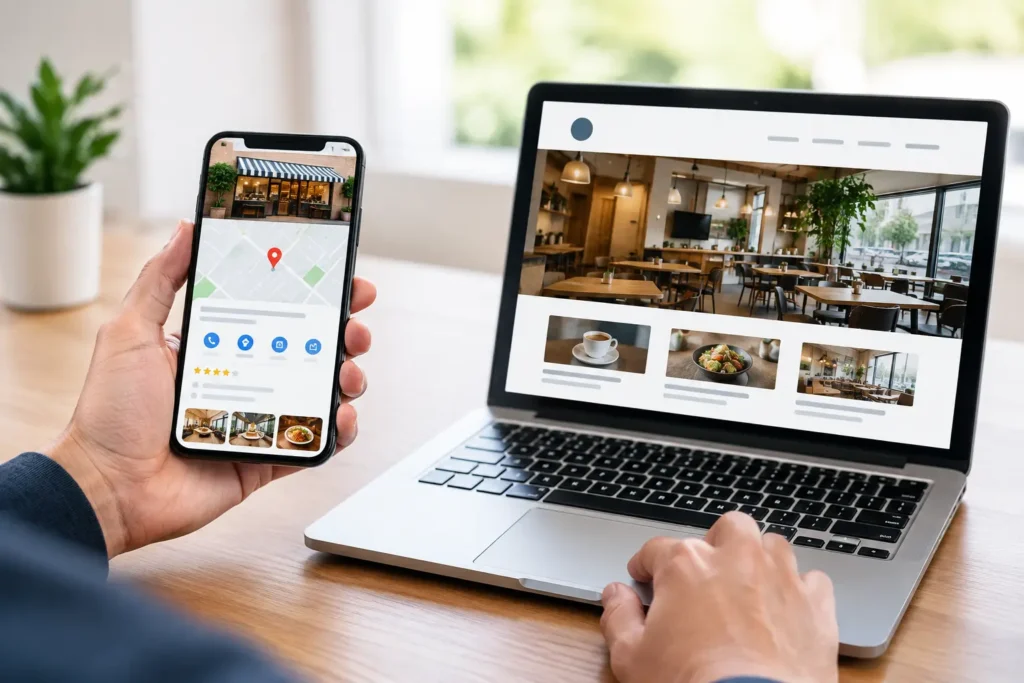
A customer searches for an acupuncturist near them, a financial advisor in their city, or a contractor who can provide an estimate this week. They may see a map listing before they see a traditional website. That is why the Google Business Profile versus website question comes up so often for local business owners.
The short answer is that neither should replace the other. A Google Business Profile helps people find and contact you quickly in local search. A website gives them the confidence, information, and next steps they need to choose you. Used together, they create a stronger path from search to inquiry to booked appointment.
Google Business Profile Versus Website: The Core Difference
A Google Business Profile is your business listing within Google Search and Google Maps. It can display your business name, category, service area, phone number, hours, reviews, photos, updates, directions, and sometimes booking options. Its job is immediate local discovery.
Your website is your digital home base. It is where you explain your services, show who you help, answer questions, collect leads, support online scheduling, and guide prospects toward the right action. Its job is to turn attention into trust and trust into business.
Think of your Business Profile as the sign that helps people find your storefront. Your website is the conversation that happens once they walk through the door.
For a local service business, the decision is rarely about choosing one platform over the other. The real question is which asset needs attention first and how the two should work together.
What a Google Business Profile Does Best
A well-managed Business Profile can put your company in front of high-intent local searchers. These are people looking for a specific service in a specific area, often with a need that feels immediate. Someone searching “tax planner near me” or “acupuncture appointment in Sacramento” is not casually browsing. They are close to taking action.
Google makes it easy for those prospects to call, request directions, read reviews, view photos, or visit your website. For businesses with a defined local service area, that visibility can produce calls and inquiries without requiring someone to type in your web address first.
Reviews are especially valuable here. A steady stream of recent, thoughtful reviews builds trust at the exact moment a prospect is comparing nearby options. Accurate hours, services, photos, and contact details also reduce friction. If your listing says you are open, answers the phone, and shows credible customer feedback, you have cleared several early decision hurdles.
A Business Profile is also an efficient starting point for a newer business. If you have limited digital assets, claiming and completing your profile is one of the fastest ways to establish a legitimate local presence.
Where a Business Profile Falls Short
Your Google listing is built for quick decisions, not a full sales process. Space is limited, messaging options are limited, and you are operating on a platform Google controls. You cannot fully shape the visitor experience, explain a complex service in depth, or build a tailored lead journey around different customer needs.
That matters for relationship-based and appointment-driven businesses. A prospective client may need to understand your approach, credentials, pricing structure, specialties, process, or availability before they feel ready to contact you. A few photos and a short business description cannot always do that work.
There is also a practical ownership issue. You control your business information, but you do not own Google’s platform, search layout, or rules. Features change. Competitors appear beside you. A suspended or incomplete profile can disrupt a major source of calls. Relying on a listing alone leaves too much of your customer acquisition process outside your control.
What a Website Does Best
A professional website gives your business room to make a clear case for choosing you. Instead of a generic description, you can create focused service pages, show proof of results, introduce your team, answer common objections, and explain exactly what happens after someone reaches out.
For example, an advisor may need separate pages for retirement planning, tax strategy, and business planning. A wellness practice may need to explain treatment options, patient expectations, insurance details, and online scheduling. A home service company may need pages for each service, each city served, estimates, financing, and emergency availability.
These pages do more than add information. They help prospects recognize that you understand their specific situation. That relevance improves the quality of inquiries and can shorten the sales conversation.
A website also gives you control over conversion. You can place an appointment scheduler where it makes sense, route form submissions into a CRM, send automated email or text follow-up, track phone calls, and create landing pages for ads or seasonal promotions. A visitor who is not ready to book today can still become a lead you nurture over time.
Unlike a profile, your website can support the complete system behind growth: visibility, credibility, lead capture, follow-up, and booking.
Where a Website Falls Short
A website cannot help much if people never find it or if it gives visitors no reason to act. Many local businesses have a site that looks acceptable but lacks clear service pages, local relevance, strong calls to action, mobile usability, or a reliable follow-up process.
A website also usually takes longer to build authority in search than a Business Profile. Ranking organically for competitive service terms requires consistent local SEO, useful content, technical upkeep, and a strong reputation. It is valuable work, but it is not always instant.
That is why a website should not be treated as a digital brochure that you publish once and forget. It should function as an active lead-generation asset connected to your operations.
When One Matters More Than the Other
If you are a new local business with no online footprint, start by claiming and fully completing your Google Business Profile while building a simple, credible website. The profile can help you appear in nearby searches sooner, while the website gives people a place to validate your business.
If your profile gets calls but your website gets little traffic or few inquiries, focus on the website’s conversion path. Make your primary service clear above the fold, give visitors an obvious next step, add proof, and remove unnecessary friction from your forms or scheduler.
If your website is solid but your map visibility is weak, improve your profile accuracy, categories, service details, photos, review process, and local relevance. Consistency matters. Your business name, phone number, address or service area, and hours should align across your digital presence.
For businesses serving multiple cities, the answer depends on how you operate. A physical office may benefit heavily from map visibility near that location. A service-area business often needs a website that clearly explains where it works and offers useful city- and service-specific pages. Trying to force a Business Profile to do the work of a location strategy usually creates confusion.
The Better Strategy: Connect Discovery to Follow-Up
The strongest local marketing setup treats the Business Profile and website as connected parts of one customer journey.
A prospect finds your Business Profile in Google Maps. They see recent reviews, accurate hours, and professional photos. Then they visit your website to understand your services, compare options, and schedule a consultation. Their inquiry enters your CRM, where an automated text or email confirms the next step and your team receives a clear notification to follow up.
That sequence is simple, but it solves a common local business problem: leads are lost not because demand is absent, but because the handoff is weak. A listing generates interest. A website captures it. A follow-up system keeps it from going cold.
To make this work, keep the experience consistent. Use the same brand message across your profile and website. Make sure the phone number works, forms reach the right person, booking calendars stay current, and staff know how quickly to respond. A five-minute response time and a clear scheduling option can outperform a beautiful site with no process behind it.
Review your data monthly. Look at calls, direction requests, website clicks, form submissions, booked appointments, and lead-to-customer conversion. Traffic alone is not the goal. The goal is a reliable system that creates qualified conversations and makes it easier for customers to choose you.
Build the Asset You Control, Strengthen the Visibility You Need
A Google Business Profile can create fast local visibility, and a website can turn that visibility into a relationship. One earns the click or call. The other provides the depth, control, and automation needed to grow without adding more manual work.
For most local businesses, the best next move is not to debate which one wins. Build a credible website, keep your Google Business Profile active and accurate, and make sure every new inquiry has a clear path to a real response. That is how your online presence starts working like a growth system instead of a collection of disconnected tools.